


What if I can’t find meaning in corporate?
Welcome to the wilderness. My name is JJ van de Vyver and I’ll be your guide on the series where we explore ideas so wild they might just work.
I spent fifteen years of my life dedicated to climbing the success ladder: working with top-tier organisations, completing an MBA at the University of Oxford, jet-setting across three continents. The higher I climbed, the further I could see and the more concerned I became. Wild animals and spaces were evaporating, corporations expected us to work more and feel less, and GDP growth seemed to be the most important goal of our species. While I achieved success, I spent most of my time indoors behind a computer, used my holidays to recover from illness, withdrew from the people around me to conserve my energy, and slowly forgot what it felt like to pursue meaning and purpose. Now I’m trying a different approach. I believe that the way we organise society isn’t working, that the stakes are high, and that time is short. I’m convinced we need to go further in questioning how we do things, and that nature can guide the way. Welcome to Wild Ideas.
Today I’d like to share a personal essay that traces my career path and my increasing desire to find meaning. I ask whether meaninglessness is a JJ problem or a feature of the economy. This is the first of five essays of this introductory series, where I’m leading you through my inner world so that we understand one another before setting off into the wilderness together.
Today’s wild idea: what if I can’t find meaning in corporate?
Journey’s end
It’s March 2025. I know what I have to do, but I’m terrified. Two weeks ago, I committed to telling him, the only question was how. I’d scribbled different versions in my notebook and almost told him once before, but it all just felt so big that I didn’t know how to vocalise my decision.
How is he going to take the news? What if my last few months at work become unbearable? What lies beyond this job? How will I earn income? I can’t believe I don’t have a plan!
I scheduled a call with my boss for Friday afternoon. No matter what, I had to tell him I needed to leave my job and move abroad. I was burnt out, my spouse was already overseas, and there were bells ringing somewhere that I was being called to answer. I joined the video call; the time had come.
18 months before that fateful call I was reaching the end of the Camino de Santiago, a pilgrimage across Spain. With 40 days and 1000 kilometres behind me, I was walking the final few hundred meters to Finisterre, a town on the Atlantic Ocean whose name translates from Latin as “the end of the earth”. There, standing before the lighthouse at the end of the pilgrimage, was a man playing the gaita, a Galician bagpipe. The hauntingly beautiful sound pierced the air of joyful pilgrims at the end of their travels and made a mark on my soul.
That evening, after breaking the news to my boss, I walked from my home in Oxford towards Christchurch Meadow. The sun was setting as my feet touched the ground alongside the River Cherwell and past my favourite tree: a mighty London Plane that overlooked the mighty view. I stopped and put my palm against its trunk, gazing up at the buds ready to burst as spring set in. I wanted to let this magnificent friend know how great a thing had come to pass. The tree was there for me on so many occasions before: sitting with inspired thoughts as I gazed towards the Oxford spires, the time I cried because my Dad was hospitalised half a world away, the time I recorded a message of congratulations for the woman who I would one day marry.
I continued my walk, adrenaline still pumping from the video call. I kept revisiting the moment my words came out, the nervousness in my stomach, the searching for traces of expression in my boss’ pixelated face. He had been so understanding, so supportive, so kind. Was I making a huge mistake?
I walked out of the meadow and onto a cobblestone street as the sun set. And there a faint sound reached me, an echo from a peninsula at the end of the world in Spain. Bagpipes. But from where? I followed the wisps of sound through the streets, past the offices I had just resolved to leave, to St Aldates – where my time in Oxford began. There, outside the Town Hall, stood a bagpipe player announcing the beginning of a student ball. The hauntingly beautiful sound pierced the jostle of dressed-up students, weary commuters and electric buses. Of course there’s a bagpipe, I thought to myself, at the end of another long journey. My eyes welled up, and I turned down the street towards the unknown.
Today I want to tell you the story that led me to walk away. I spent years searching for meaning within corporate structures, climbing the ladder as high as I could. The more I saw, the more unsettled I became. I couldn’t see the whole picture at first; it arrived one piece at a time. I’ll share each piece with you, before we zoom out to see how they fit together.
Piece 1: What I chose to study
It was another Friday night in 2012 and I was distraught, speaking to my mom on the other side of the country. I blamed her so much for this, and I wonder whether calling her in the midst of my crises was a way to force her to share in my pain. Tomorrow was Saturday, and every second Saturday we wrote six hours of tests on financial accounting, management accounting, taxation and auditing. My distress wasn’t just the pressure of the tests; it was the hopelessness of this whole degree. I was trapped between a set of subjects I hated and my fear of being seen as a failure. I’d watched others drop out or change course and judged them as weak. Despite all my anguish, I wouldn’t take responsibility for pursuing accounting and so I wouldn’t take a decision to study something else.
Before I started my accounting degree, my mom and I sat at a broad wooden table in the bright South African sunlight opposite an esteemed career counsellor, going through the psychometric report showing my skills and preferences. The career counsellor’s job was to match my profile against suitable career pathways. “You could explore engineering or actuarial science,” she explained, “but the best option really is to become a Chartered Accountant.” “Why?” my mom asked. The counsellor drew a pyramid, with different levels. “You see, so many jobs enable you to be a fish”, she explained as she drew little fish shapes from the bottom up. “But as a Chartered Accountant,” she said as she circled the top of the pyramid, “you get to be a dolphin. You’re at the top of the food-chain, not a fish getting eaten along the way.” With that metaphor on that dry Johannesburg morning, it was settled. I didn’t know what accounting was, but in a budding democracy with high unemployment, being a dolphin meant surviving. It was all my parents had worked towards, pouring their income, energy and dreams into our education. I could do what I wanted, but after my financial future was secured through an income-generating degree.
Back in Stellenbosch that Friday night in 2012, I told my mom how much more meaning I found in the philosophy and psychology classes I was attending on the side. At least when I left a lecture on human behavioural scripts, or on the western world’s fear of death, those insights shaped the way I lived my life. Accounting was a set of rules for its own sake and had little to offer on navigating a worthwhile mortal existence. “Then why don’t you change, my boy, and study psychology instead?” my mom asked. I stilled at this invitation. Was there any economic use in understanding psychology or philosophy? A joke on campus at the time asked, “what’s the difference between a bachelor of arts degree and a pizza?” The answer was “a pizza can feed a family of four”. There was no escaping it: the subjects I cared about could be hobbies, but ultimately I needed to succeed. And success meant being able to feed a family of four.
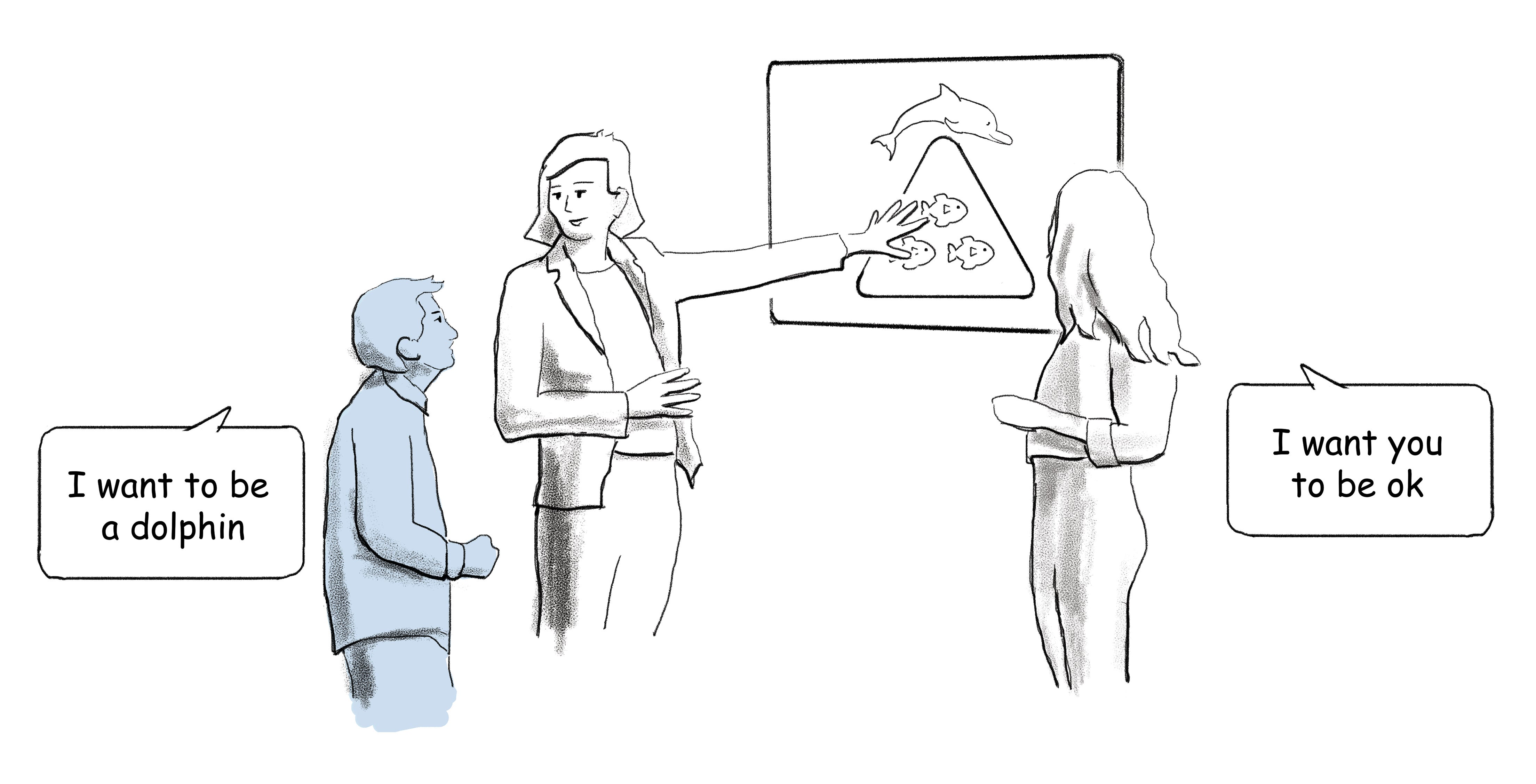
Piece 2: How I spent my working hours
One of the most striking things about starting a job was the contrast between the students at the university residence where I lived while studying and the working people I encountered as I audited companies. At Stellenbosch I lived in a residence with 210 other students; we were one of many residences across campus. Each year the students invested hundreds of hours organising sports, cultural and social events, forming part of teams, committees, sub-committees, even congregating in house meetings once a quarter where we debated and amended the house rules – all for free. In contrast, people were paid to show up five days a week in their jobs and yet they were so dissatisfied that they counted down the days to the weekend. It was so obvious that our students found meaning being of service in a community where they felt they belonged. Meanwhile all these workplaces assumed that only money motivated people, and it seemed a huge number of people didn’t want to be in their jobs.
I wasn’t immune for long. By April 2015 I was midway through the three-year training contract needed to qualify as a chartered accountant. I clung dearly to the Alan Watts lectures and Freakonomics podcasts that stimulated my thinking during the long drives to and from the office. My days were filled with the soul-draining work of requesting invoices and transcribing them to excel. One particularly difficult Friday I was speaking with our client Lorraine about how things were going. Our conversations were a breath of human kindness during my time at a tough client. We got onto the topic of happiness. Lorraine shared that she’d been to a church service where the pastor had spoken about suffering in life. She breathed a small sigh and wondered aloud, “maybe the human condition is suffering… and we’re just born to be unhappy?”
I drove the long road home feeling conflicted. There was no way that I had come into existence, as unlikely as that is, to be miserable for most of my waking hours. It just couldn’t be; the whole of my being rejected it. And yet here I was, experiencing this overwhelming sadness, this lack of meaning…
I drove to the shopping centre where a high school friend worked in a crystal shop. Stuart had trained as a sangoma, an African traditional healer. He’d recently invited me to a weekend retreat involving crystals and magic mushrooms. I felt nervous and unsure about whether I wanted to be anywhere near psychedelic fungi. And yet, as I walked into the shop that evening, my defiance and sadness melted away in his rooted presence. I told Stuart how lost and unsure I felt, about everything. The clarity and slight hint of mischief in his voice put me at ease and our conversation turned to the weekend retreat. “Nothing makes any sense at the moment Stuart”, I said, “and yet I feel like I need to be there”.
I hadn’t expected to find myself in the autumn fields alongside a roaring fire under the Easter full moon that weekend. I hadn’t expected some fungi to occasion my oneness with all of being and to awaken my desire to explore my inner world. The following week I told my managers I was considering leaving the firm and that I’d take a month to make a decision. The longer I reflected the more obvious it became that my work ultimately lay in the outer world, and that having credibility would be a defining feature of the future I wanted to create: I would be more effective inside the boardroom than picketing at its doors. A month passed. I let my managers know I would continue my training contract.
It was the first time in my entire accounting path that I had truly given myself the option to quit and actively made the choice to stay. It was incredible how much less I suffered, even in miserable working conditions, as I worked towards a goal that I took responsibility for. But even though I could better tolerate the demands on my attention, I couldn’t shake the question… Why were so many people stuck in jobs that they didn’t find meaningful?
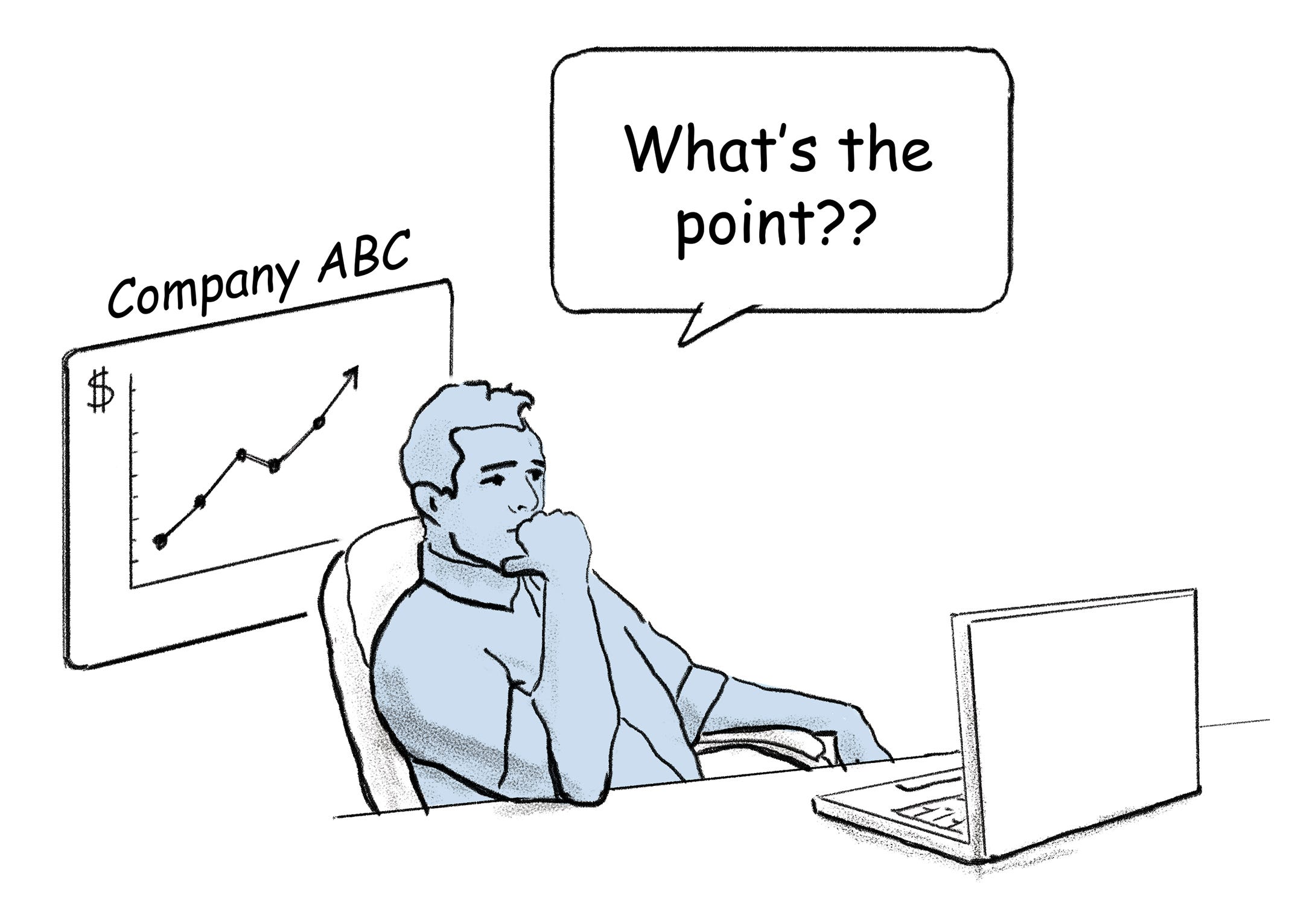
Piece 3: Which jobs are deemed valuable
It was an unusually warm and sunny afternoon in England in September 2018. We were walking north along the Oxford Canal past house boats, pedestrians, swans and the last glistening green leaves of the setting summer. Shruthi is one of those people who gift you the fullness of their attention: the kind of listening that forces you to consider whether you mean the words you’re saying. We met at a welcome dinner for Oxford University’s MBA class the previous week. She had just completed the course herself and invited our incoming class to consider the community of people that had enabled each of us to attend such a privileged institution.
Roughly half-way through our canal-side conversation Shruthi turned to me and said, “JJ, it sounds like you don’t believe you can do what you love and earn money at the same time.” Her observation struck me like a bolt of lightning: here, in plain daylight, was the belief that defined my struggle with meaning at work. I’d changed from finance to management consulting after finishing my training contract and yet I still felt I had to progress my passion projects outside of business hours because my work wasn’t meaningfully contributing to the world.
But how could I reconcile these opposites, and earn income doing what I loved? My mind raced. I hadn’t seen it done. The people who made the biggest impact across my life – teachers, mentors, spiritual guides – sometimes struggled to make ends meet. Later when COVID-19 forced us all indoors the idea of essential workers arose in the UK: people whose jobs were so important to society that they were asked to continue working despite the risks to their health. These essential workers didn’t work in high-rise skyscrapers in central business districts, they were nurses and doctors, police and firefighters, truck drivers and supermarket staff. They were people who meaningfully contributed but who were constantly needing to justify higher pay.
Shruthi and I paused under a tree before walking back towards the city centre. We both understood that being aware of your beliefs was the first step towards shifting them. In that sense, her observation was a gift: being able to see that I believed my income and meaning were like oil and water was the beginning of choosing differently for my next job.
And yet, at this mythical university surrounded by 320 people from over 60 countries – the best and brightest from all over the world – it still felt like my search for meaning was a lonely one. Large numbers of our cohort were dead-set on finding their way into those high-rise buildings: investment banks, hedge funds and consulting firms. Why? The market rewarded them with income, prestige and success. I had wanted the same things once, but now I wasn’t so sure… It didn’t make sense that our generation’s top talent was spending their time maximising investor returns and engineering profit rather than working on the real challenges we faced.
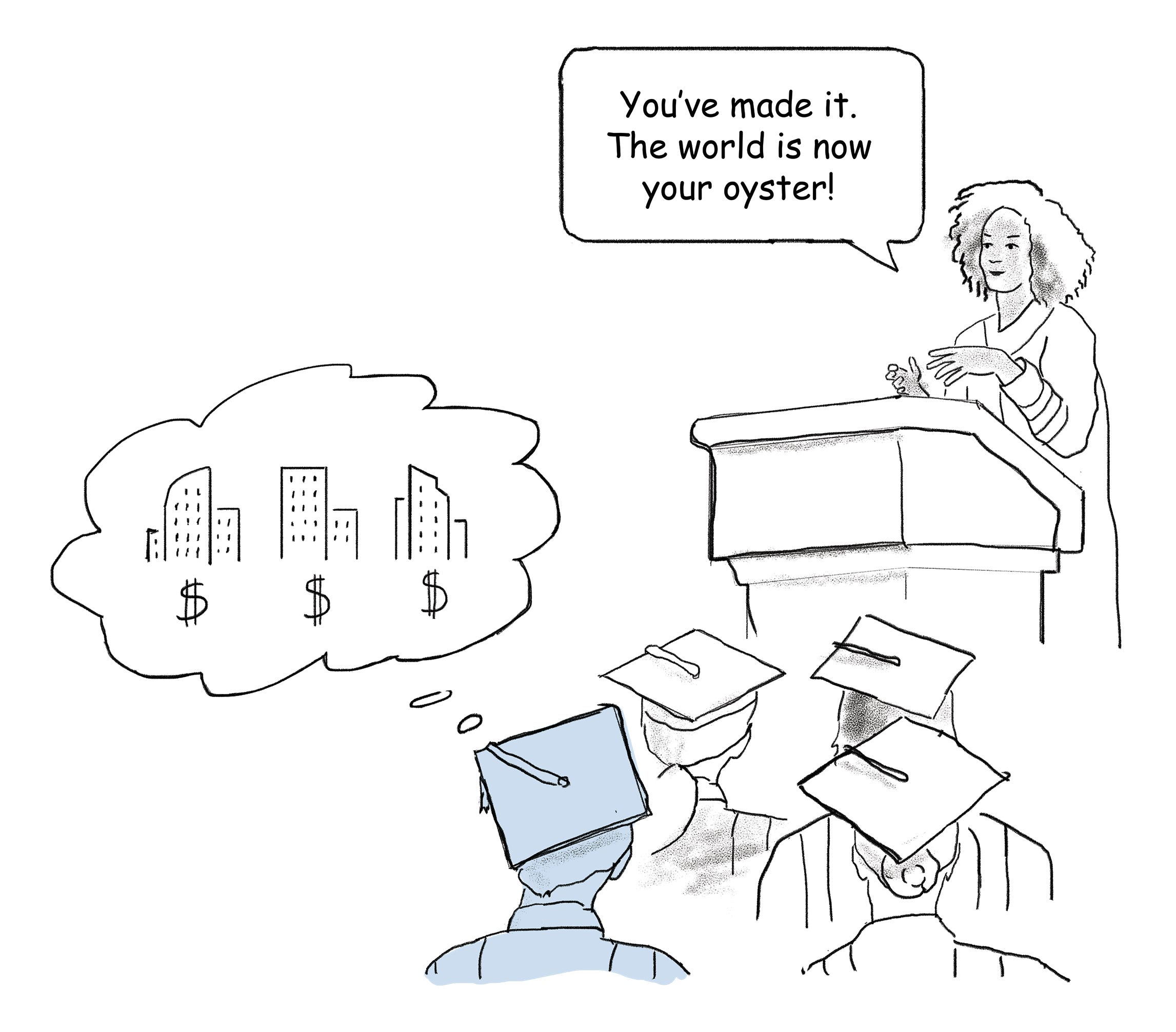
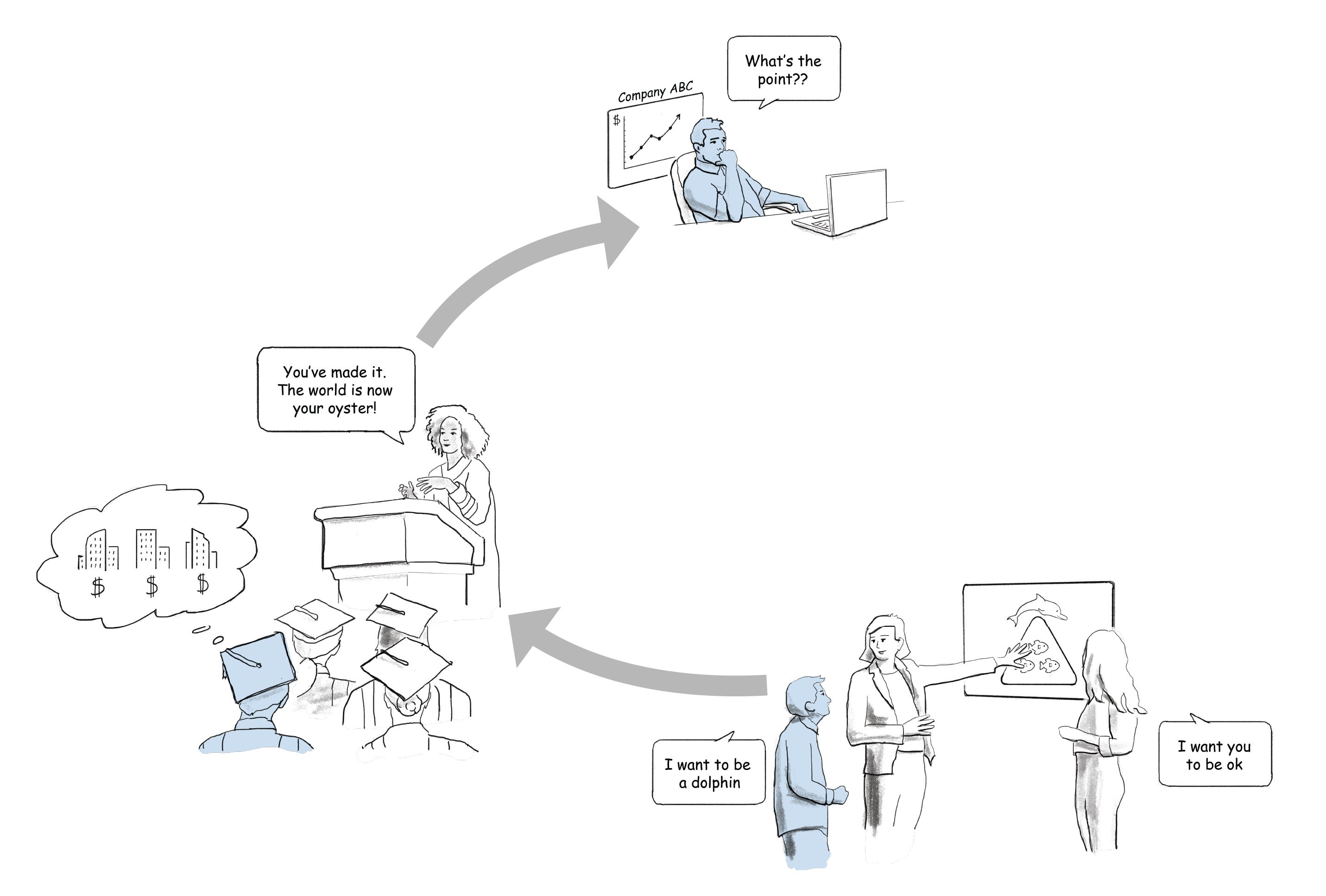
To recap the pieces of the picture we’ve explored so far:
we’ve traced my experience studying a degree that promised financial security after a conversation with a career counsellor,
through to feeling my work in accounting and management consulting wasn’t contributing significantly to society,
and realising that many of the talented people at Oxford from all over the world also aspired to be successful in the traditional sense.
Piece 4: How success is measured
We’d been in Oxford just two months and our first examinations were fast approaching. Today it was my turn at the podium: I was helping classmates who had never studied accounting before. I prepared for my support class by devouring old study notes, carefully distilling accounting down to its simplest building blocks. While revisiting the content from all those years of anguish, something new clicked into place.
My class began, “accounting is a language, codified by international bodies, to enable stakeholders to understand the financial position and performance of a business”. It was so simple: businesses transact in the world, and accounting looks at those transactions and helps you to interpret them according to a set of rules. You can categorise every single relationship a business has by whether it is likely to lead to cash flowing into or out of the business. The language of accounting grew out of the need to understand what was happening inside a company, and to measure whether that company was growing its shareholders’ investment by bringing in more money than was going out.
Our accounting exam came and went, but the importance of language stirred in my consciousness. One afternoon I met two classmates at the Westgate shopping centre, a monument to consumerism and the most recent spire added to the Oxford skyline. We sat in the glow of the setting sun above the city streets eating popcorn. Manasi is a kind, wise soul with still waters that run very deep, while Tanya brings both fire and compassionate grace to creating community. Our group chats were a ritual and on that day we discussed language. “What is it like to speak five languages?” I asked Manasi in awe of her multilingualism. I had grown up hearing Afrikaans and German, but my parents decided to raise us in English because it was the international language of business. Manasi explained that languages mapped the attention of cultures: there were words for things in Marathi, for example, or Hindi, that captured concepts or experiences that simply did not have an equivalent in English. Through seeing what one language made visible and the other not, you could get a sense of what a culture perceived and valued.
She was right. I’d read that numerous Aboriginal Australian cultures did not have a word for ‘ownership’ quite like their Anglo counterparts when the latter arrived by ship in the 1700s. The indigenous people’s relationship to the land was one of custodian and guardian: you belong to the land and it is in your care, it is not something that belongs to you to extract from. I’d also heard that indigenous North American cultures placed an emphasis on verbs rather than nouns, referring for example not to a “coastline” but pointing instead to where “coasting” happens. In this framework, the world is a living, breathing place, not a collection of objects stripped of animacy. And back home in South Africa I was familiar with the Zulu term ‘ubuntu’, which roughly translates to ‘I am because we are’. One’s existence is informed in relation to others – community is front of mind, not individuals. The conversation with Manasi took a pause and an electric bus rounded the street corner below. I wondered whether thinking in English made me more likely to see land as something to be owned rather than cared for, the world as a static environment rather than a breathing web, and the individual as more fundamental than the whole.
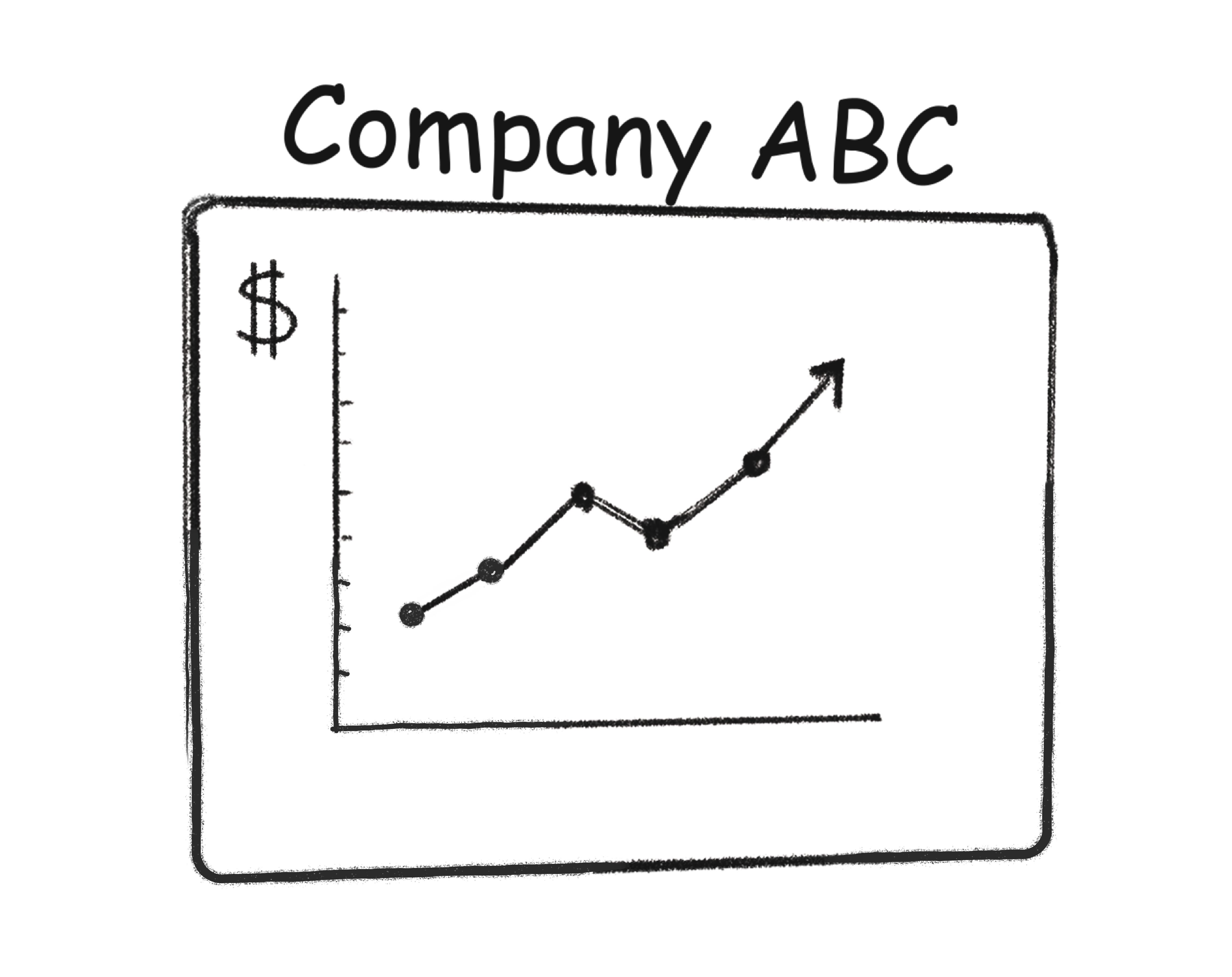
I was also struck by the idea, where did thinking in accounting lead us? This quantified language of numbers has no words for the wellbeing of humans or the health of nature. Human capital and environmental capital are de-emphasised because they have no accounting value unless you can associate a cashflow with them. And so companies measure the success of their actions by how much accounting profit they generate without the need to account for whether those same actions harm society or the natural world.
Piece 5: What organisations prioritise
I’d never considered myself an environmentalist and I’d never really thought much about the climate. This changed over the course of a single lecture given by a passionate woman with a clear and urgent mission. Gillian would become a friend with time, but on this day in 2019 she was an ex-MBA and fellow South African who had spent a year exploring business solutions to climate change. Two things have stayed with me since her presentation to our class:
First of all, the alarming graphs showing how both carbon dioxide concentrations in the atmosphere1 and the global temperature2 have tracked together, shooting up especially since the 1950s. It turns out that visuals are typically much more likely to stick with a person than numbers, and these visuals were unequivocal in how radically our climate was changing because humans were pumping CO2 into the atmosphere.
Secondly, my anger about the corporate cover-up of this knowledge. ExxonMobil, one of the largest historic corporate emitters3 of carbon dioxide, knew as early as 1977 that carbon dioxide was contributing to global warming4 and yet spent decades publicly questioning the science that they internally took to be true56.
What were we doing to our planet? Why would any group of people lie about something so potentially catastrophic? As Gillian was at pains to point out, it’s not Earth that is at risk of collapse, it’s human civilisation. I felt so betrayed.
Over the next few years, I read and watched and listened as several corporate scandals came to light:
First, the Boeing 737 MAX was grounded in March 2019 after Ethiopian Airlines Flight 302 crashed shortly after take-off7, just five months after Lion Air Flight 610 did the same. A new handling system, MCAS, malfunctioned in both cases and the pilots did not know what it was or how to override it8. It turned out that Boeing had concealed MCAS from both pilots and the regulator because they were under enormous financial pressure and it was faster and cheaper to certify the 737 MAX if the controls appeared similar to previous 737 models9. MCAS was excluded from manuals and training materials, the 737 MAX was certified to fly without pilot retraining, two sets of pilots had no idea why their planes were fighting to point their noses towards the ground, and 346 people lost their lives10.
McKinsey & Company, one of the most prestigious global management consulting firms, was hauled in front of US Congress and questioned about its role in supporting opioid manufacturers to quote “turbocharge” sales of opioid painkillers in the US11. This was against the backdrop of the opioid crisis. McKinsey had formulated strategies for Purdue Pharma’s sales force to target “High Value Prescribers” of OxyContin12. They’d also performed work for both the FDA and Purdue Pharma despite the conflict of interest13. And finally, they destroyed evidence from their work during an investigation into Purdue Pharma’s conduct14. In 2024, to resolve the investigations into them, McKinsey agreed to pay $650m, implemented an enhanced compliance programme and agreed not to do any future work in controlled substances.1516
In 2023 the chemical manufacturers 3M and DuPont agreed to pay billions of dollars to US public water utilities and municipalities to cover the cost of removing PFAs (per- and polyfluoroalkyl substances) from the drinking water supply1718. These “forever chemicals” were pumped into waterways as waste during the manufacture of non-stick products such as Teflon and were detected in the blood of Americans in the 1970s19. Despite internal testing confirming the contamination20, the companies settled the environmental cases without admitting wrongdoing. PFAs have been linked to health problems including decreased fertility, high blood pressure in pregnant women and an increased risk of some cancers21. They are incredibly stable chemicals, do not occur naturally and have now been found in surface- and ground-water worldwide22.
This is to name just three, well-established, outrageous cases. We haven’t even touched on the addictive hi-jacking of attention by social media apps, the rise of political polarisation aided by news outlets or the rush to create superintelligent AI.
The problem in each of these situations is not that there are bad people in these organisations. Most employees and leaders are normal, hard-working people like you or I, doing their best to progress their careers and provide for their families. The problem is that these organisations are created in legal frameworks that require them, on the margin, to think about making money for their owners rather than creating net societal benefit. And in each case above where these companies put profit first, people and planet suffered.
We’ve created multinational super-organisms whose goal is to maximise financial profit and set them loose in the world, hoping that somehow under-resourced national regulators can constrain the harm that they create. Just to give you a sense of scale: if you combine the 2025 list of countries’ Gross Domestic Product23 (the financial measure of all goods and services produced by that country in that year) and the 2025 list of global company revenues24, then 41 of the top 100 largest economies in the world are companies. That’s almost half of the biggest financial entities on Earth. These corporates are enormous agents on our planet.
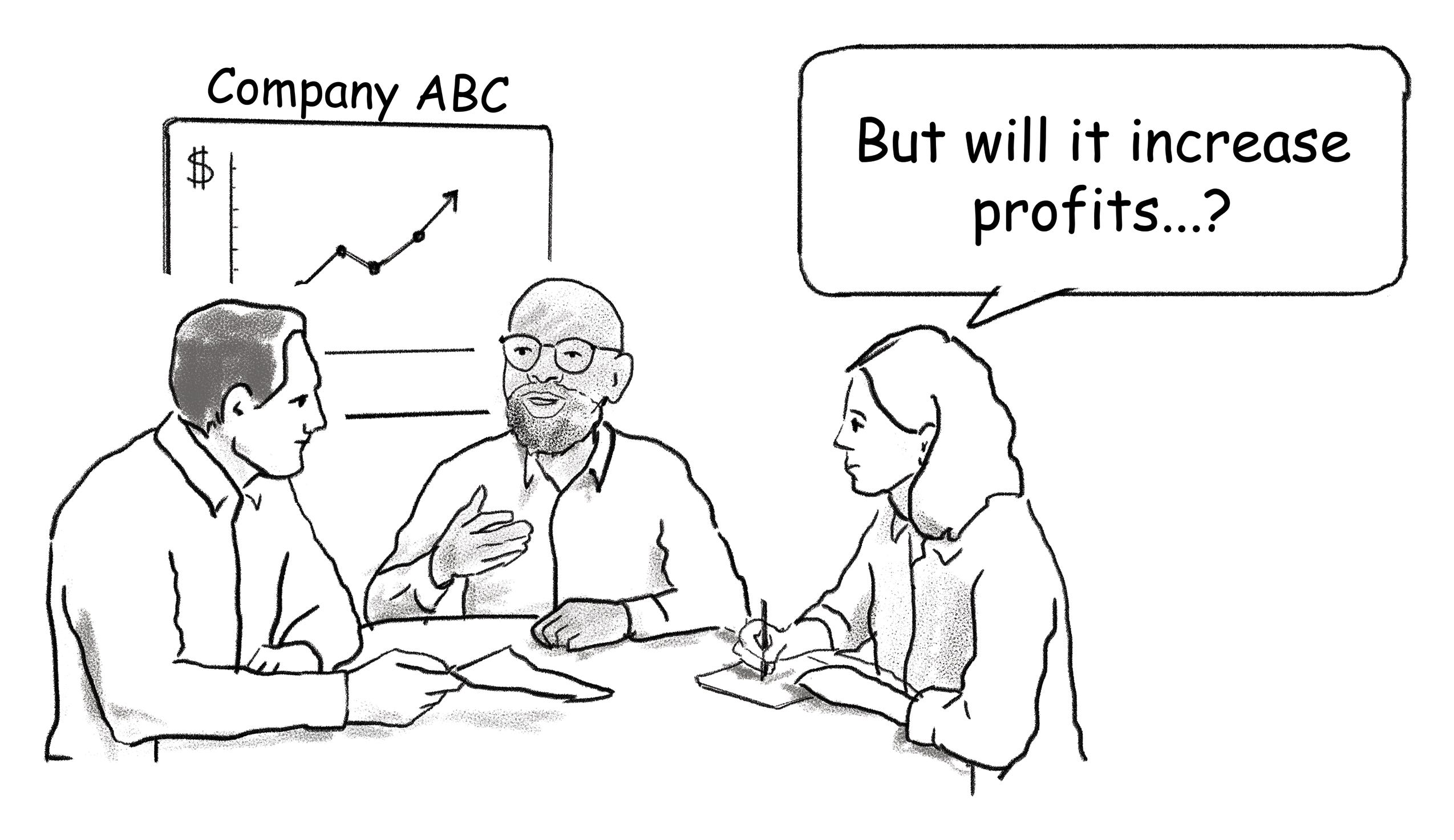
Some of the largest groups of people that have ever assembled are spending their time in organisations trying to figure out how to maximise income and minimise cost. My well-meaning decision to work in corporate to progress and provide over my career places me in an incentive structure that prioritises profit. And many, many people doing the same thing results in corporates that are undermining human society and the conditions for life on our planet.
Piece 6: Where money is invested
My uncle once advised me to position myself close to the “basket” in my career because then I’d be able to score “points”. He was talking about being near where money is made. To know where money is made, all you have to do is follow where financial investment is flowing.
It was a chilly, typically grey October London afternoon in 2025. I had just completed my annual pilgrimage to the Wildlife Photographer of the Year exhibition at the National History Museum and was walking across the straight lines and managed landscape of Kensington Gardens on my way to see an old friend. I had just read that the United Kingdom was one of the most nature-depleted areas on the globe according to the Biodiversity Intactness Index in 2025, no doubt because so much of its land has slowly but surely been transformed to conform to human taste.
Jess is a fiery, determined spirit who I know from our days at a top audit firm in Johannesburg. We were catching up on work, the cost of housing, where home is and my imminent move to the US. For as long as I’ve known her, she has been adamant to succeed swimming against the current of testosterone within the world of private equity. I asked her questions about this elite, prestigious world of deal-making where the winnings are often huge. It is certainly close to the basket where you score points. Jess is refreshingly honest. “JJ, I’m not sure that private equity makes the world a better place. Typical PE means coming in, buying out a cash-generating business, loading it with debt, trimming down costs, and making as big a return as possible for the Limited Partners”. A Limited Partner is the investor providing capital to the private equity firm, I clarify. She continues, “Often it sucks the soul out of the companies that a fund invests in. But you can make a lot of money.”
It wasn’t the first time I’d heard doubt about the societal contribution of highly profitable investments. Tulsi, a peer on the MBA who had worked in education, was reflecting on the fashion at that time around creating apps. Early startup investors, sure that children would soon be educated by tablets, were on the hunt for EdTech apps that would scale and generate the return-on-investment multiples that their money demanded. “If you want to improve education you can’t just invest in apps.” Tulsi protested, “We have all had the experience of the teacher who cultivated your passion for a subject. But you can’t scale care and attention the same way you can scale an app, so it’s not sexy for investment.”
Back at lunch with Jess, I was reflecting on the strange wilderness that awaited me across the Atlantic in the United States. In the biggest market on the planet, weight-loss drugs had taken off at exorbitant prices. Wasn’t it wild that the fast-food industry profits off of selling you unhealthy food so you gain weight, the pharmaceutical creators of weight-loss drugs profit off of suppressing your appetite so you lose your weight again, and the insurance industry profits off of making these drugs more affordable for you (if you can afford insurance). Somewhere in all of that extraction there are human beings doing their best to nourish their miraculous bodies.
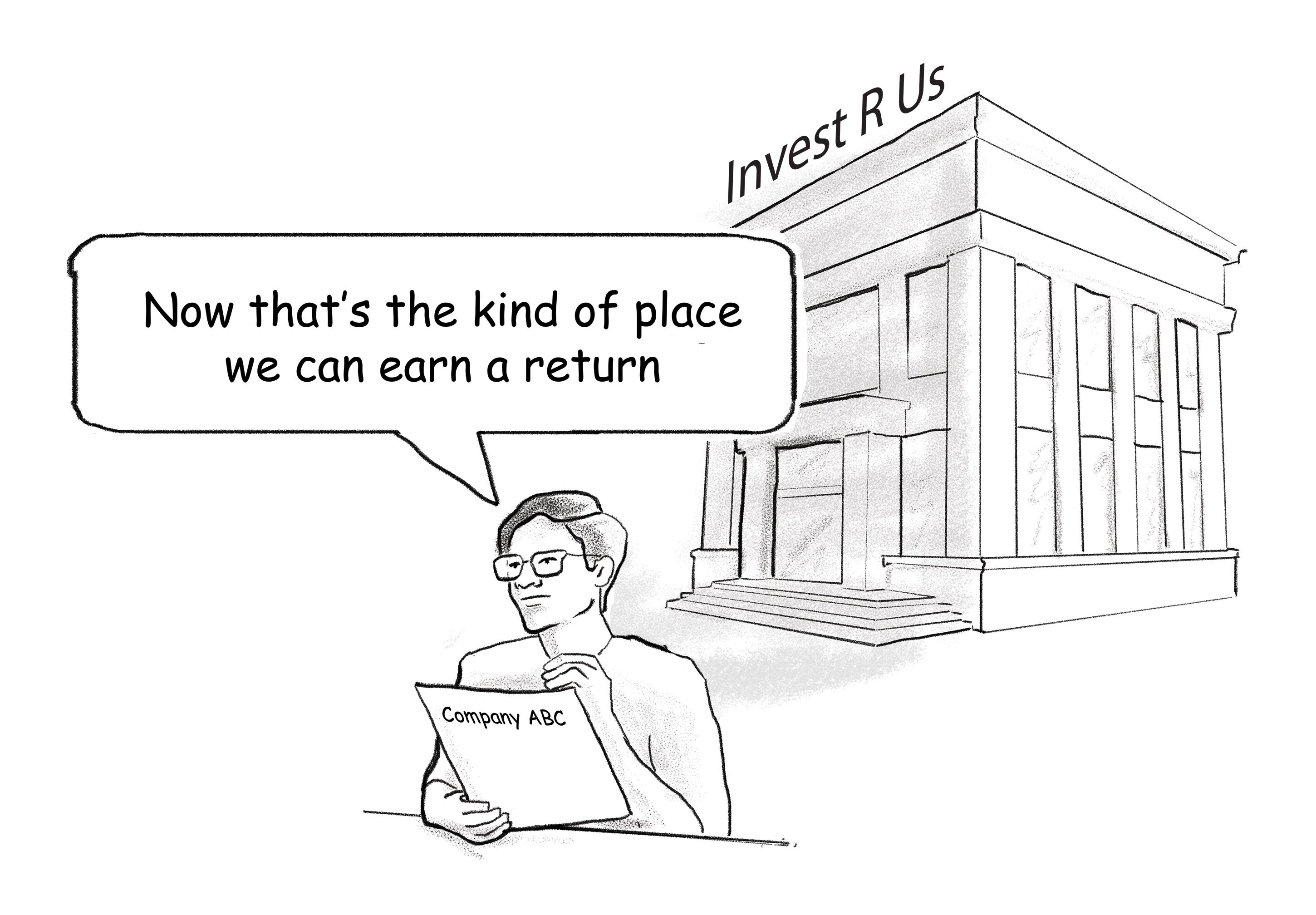
Jess and I finished our meal and said our goodbyes. I made my way towards Paddington Station on foot, thoughts swirling through my mind. Money, especially private money, was flowing towards ideas and businesses that offered the best return-on-investment. In that process, we were underinvesting in care and attention – things like education, healthcare, regenerative agriculture, infrastructure, rewilding, clean energy, spiritual development – where the financial bang for buck is low. Our society was fuelling industries that take good things and turn them into financial returns. I was less and less sure about the appeal of scoring points in the proverbial basket.
Piece 7: My return on investment
Despite studying finance, qualifying as a professional accountant and completing a Master of Business Administration at the University of Oxford, I only really started to feel personally financially capable much later. Of course I had read Rich Dad, Poor Dad, understood the time value of money and knew what stocks, bonds and fixed deposits were. But I’d never been taught to look at my relationship with money, my assumptions about wealth and to figure out how to save or invest my own financial capital. Not until a course I did in my 30s25.
And so now I have a spreadsheet of my investments and each month I sit down to a “money date” where I check how my saving goals are going, how my investments are performing and how my relationship patterns with money are evolving. It’s mind-boggling to me that we aren’t taught these basics at school.
It’s my December 2025 money date and everyone is speculating about whether we’re in an AI bubble and if, or when, it’s going to pop. I wonder whether I’m overinvested in stocks, although others assure me I’m not: I’m young enough to withstand crashes in the market and there’s way too much potential cumulative upside to miss out on. The mantra is time in the market, not timing the market.
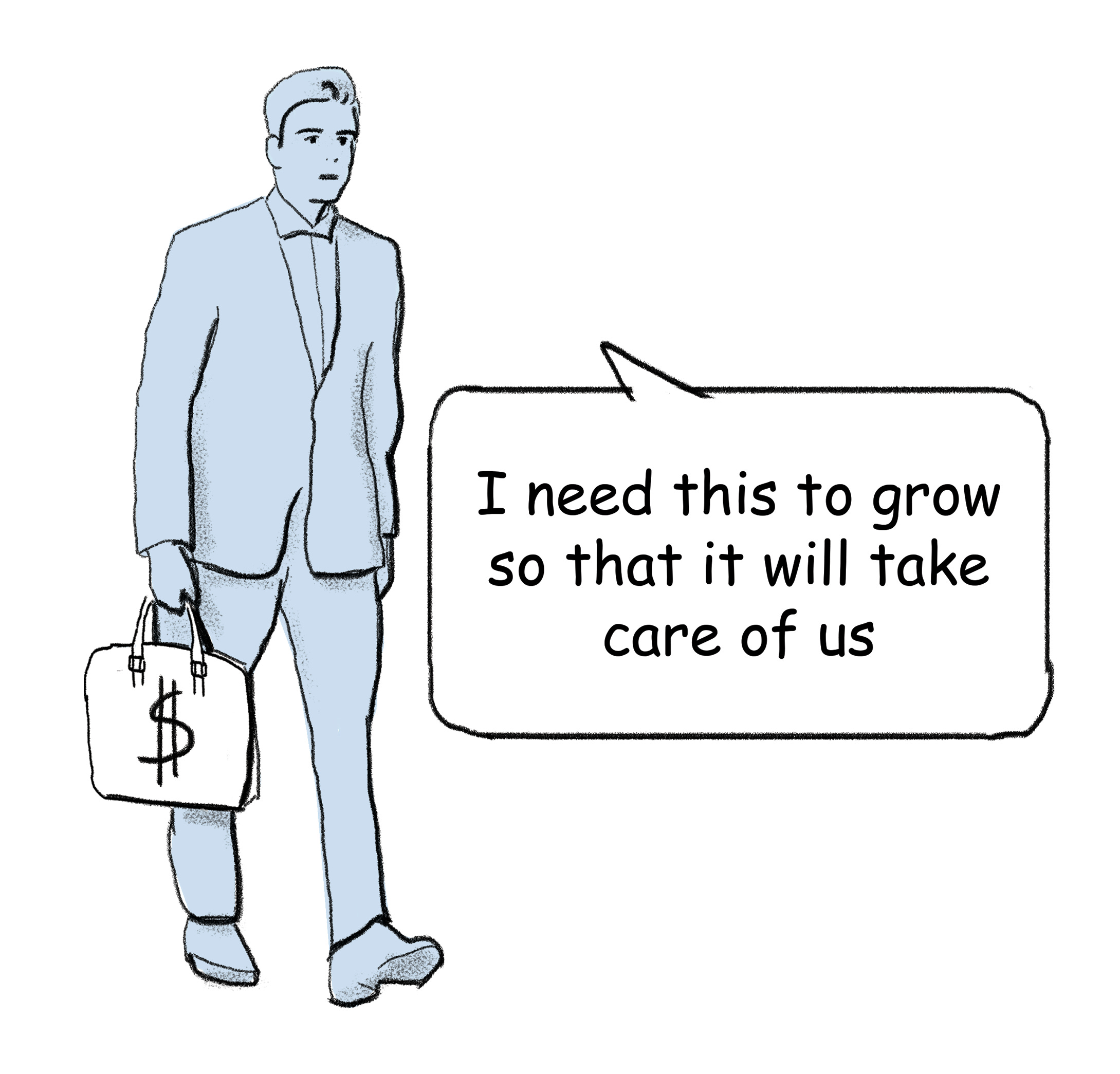
It occurs to me that this ritual of reflecting on my financial investments makes me an investor. My goal is financial independence: a point when I’m generating enough cash from my financial assets that I don’t need to sell my time through working a job. It turns out inheriting or accumulating assets and investing them is the only way to escape the “rat race” of selling your time. The economist Thomas Piketty pointed out that when the return on capital is higher than economic growth, those without capital can be left behind26. That’s because when the pie of the economy grows from year to year, say at 2%, that growth arises from inputs such as money and labour. If the return on money is bigger than 2%, say 7% or 8%, then the people who have invested money are getting back a relatively bigger portion of the pie. If you’re selling your time under the same circumstances, your salary may grow but it’ll never compound the way that money will. I invest because I want my money to work for me – I want it to grow.
And to grow, I’d like to see it earn the best return-on-investment. Which is why it matters how much of my money is in stocks or start-ups or property or cash.
I look around me and realise that as I grow older this growing stash of financial assets will become more important to me. I, too, will resent attempts to take it from me through wealth taxes, because it’s mine. I’m certain it arose mainly from my personal efforts and discipline (and not the incremental privileges, opportunities and historic events that led to my being in the right skin at the right time). I, too, will seek to pass it on to my kids through tax-efficient legal structures that you need lawyers and accountants to set up, because I want them to have the best start to their lives. I might encourage them to study accounting.
The numbers in this spreadsheet matter so much to me because that money is security: it pays for all of the scarce resources I care about, like healthy food, quality education, dignified housing, clean air, pure water and durable clothes.
It’s odd that these basics should be scarce at all in a world with abundant natural resources and human knowledge, technology and time. We already produce enough calories to feed everyone on the planet27, and yet roughly 1 in 13 people faced hunger in 202528. The provision of life-affirming air, water, housing, clothing and education is absolutely within our collective means to produce, but these basics are scarce because we’re not pouring our attention into creating them. Instead, our financial investments, and thus our businesses, and thus our workforce, are playing the game of endless financial growth, where we capture resources into private ownership and maximise our return-on-investment.
Putting the pieces together
And suddenly the pieces of the picture form a coherent whole. I can see how my need to grow my assets to pay my own way through life creates an entire system that I spent my life trying to navigate and understand. Let’s start at the end. Because we need our financial assets to grow (piece 7), our financial capital is being invested in the ideas that will generate the highest returns (piece 6), and those companies are taking shortcuts to maximise profitability even if it hurts society or the planet (piece 5), because they’re measuring success in a language that has no words for your children’s quality of life or the trees releasing oxygen or the rivers providing water (piece 4). Talent everywhere is encouraged to seek jobs where they can find financial success (piece 3), even if those jobs turn out to be meaningless or harmful (piece 2). And thus the next generation is learning skills that the financial economy demands, not what our human moment asks for (piece 1). Every piece reinforces the others in an interlocking cycle of misguided human attention and exponential financial capital, undermining the environment and eroding the social fabric in its wake.
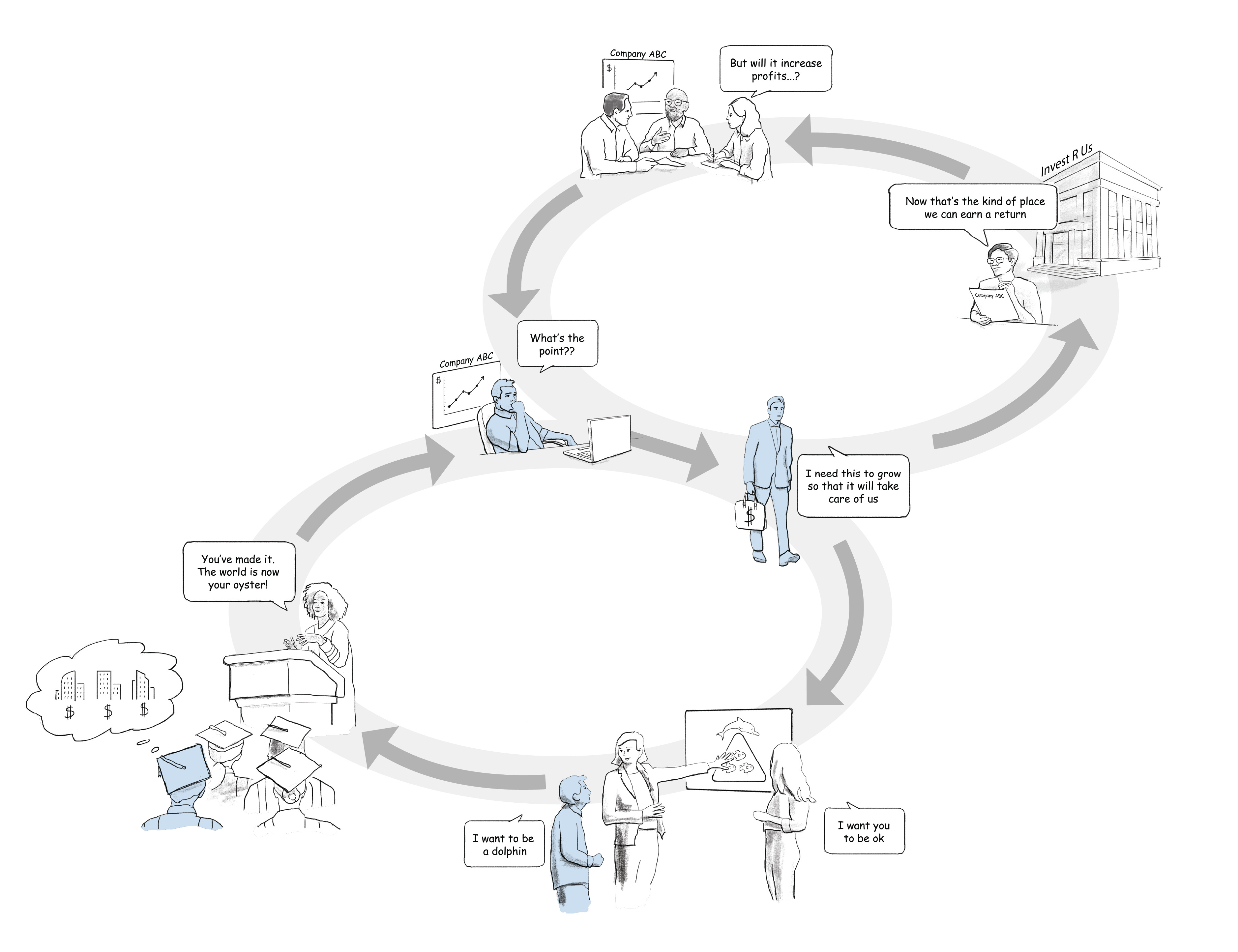
And so, it is I that complete the picture, forming part of the chain of attending to financial outcomes. All this, on the increasingly dubious assumption that by generating more financial capital we’ll maybe achieve the things we really care about, like a future for our children, like leaving the world better than we found it, like having time to be with our loved ones over our short lives. And even as inequality climbs and we punch through planetary boundaries, still we pour our attention into the myth of endless financial growth, because we don’t know how to organise our collective efforts around the things that actually matter.
I wonder whether we would need to work as hard if we poured our attention into creating social and environmental abundance rather than the endless financial growth our runaway system now requires of us.
I wonder whether we could become worthy custodians of future generations and the only other lifeforms we’re aware of in the observable universe.
I wonder if things could be different.
I wonder what to do now that I can see the full picture, and whether it’s naïve to think we can organise ourselves differently, and whether other people have had similar experiences to mine.
I wonder, what if I can’t find meaning in corporate?
A seed of hope
I do not know what all the necessary changes are, nor how each will come about. That’s the work of many to co-create. But it seems to me self-evident that our current financial logic will result in mass extinctions, a degraded Earth and exacerbated human conflict based on actual scarcity unless we can step into a different way of being.
I hope for a future where:
Our youth study fields that sustain and enrich life on this planet and beyond,
Work is increasingly dignified and meaningful for people who are celebrated for being of service to others,
People are actively encouraged to take up careers that contribute to humanity and nature,
Our measurement of success includes non-financial metrics that tell us about quality of life,
Organisations prioritise social and environmental outcomes, achieved through financial sustainability,
We invest our collective money, time and attention into organisations and causes that responsibly embody a future worth inhabiting, and
Independent financial self-sufficiency gives way to interdependent flourishing.
Perhaps the dearth of meaning I felt in corporate was my body signalling that I can’t be well contributing my energy towards a system that makes my body and the body of our planet sick. Perhaps meaning was my guide towards pursuits that affirm life on this Earth. Perhaps meaning will flourish when we apply ourselves to reimagine the system that is currently propelling us towards an evolutionary cliff.
That evening in Oxford, burnt out and weary after years of seeking, I walked a cobblestone street following the sound of bagpipes. I knew I’d reached the end of a chapter, but I couldn’t yet see what lay ahead. Would I ever find meaningful work?
A few weeks later I stumbled across an online conversation holding a powerful clue. John Vervaeke asks two questions to help people who are seeking meaning in their lives29:
What do you want to exist even if you don’t?
…and how much of a difference do you make to it now?
May we all find the courage to pursue what matters in this “one wild and precious life”30 we’ve been given.
Afterword
Thank you for walking through the wilderness with me. In the next essay I’ll be exploring spirituality in the cathedral without a roof, revisiting how I lost my father and found my faith. Next time our wild idea is: what if you were meant to be there when Daddy died?
If this work resonated with you, subscribe and share it with others. Spread the love.
Acknowledgements
A huge thank you to:
Barbara Okhrati for her skilled hand in creating the visuals for the print version of this piece
Ben and Hunter for the generous feedback on early drafts
Dan Perez for his audio recordings of gaita music along the Camino de Santiago (in the audio version)
Phillip-Jan van Zyl for his beautiful piano collection “Spiral” (in the audio version)
Leigh and Lesanne for encouraging, supporting and shaping this work
Louise for guiding my way to inspired creativity
My partner Ash for your patience and support throughout this project
The many wonderful humans who inspired these words through our conversations.
Further attribution:
Jain, M. (2026) Spiral staircase of Vatican Museums in Vatican City. [photograph] Pexels. Available at: https://www.pexels.com/photo/spiral-staircase-of-vatican-museums-in-vatican-city-36755131/ (Accessed 24 August 2026).
Music by Kyle Preston and sound effects under licence from Artlist (in the audio version)
Some of the names in this piece have been changed at the request of individuals.
Wild Ideas is produced by JJ van de Vyver. Views expressed are mine alone and don't represent my clients or any organisations I'm affiliated with. Nothing here is professional advice of any kind. Any examples drawn from professional work are anonymised or composite.

Scripps Institution of Oceanography (n.d.) The Keeling Curve. [online] UC San Diego. Available at: https://keelingcurve.ucsd.edu/ (Accessed 16 August 2026).
NASA Goddard Institute for Space Studies (n.d.) GISS surface temperature analysis (v4): analysis graphs and plots. [online] Available at: https://data.giss.nasa.gov/gistemp/graphs_v4/ (Accessed 16 August 2026).
Heede, R. (2014) ‘Tracing anthropogenic carbon dioxide and methane emissions to fossil fuel and cement producers, 1854–2010’, Climatic Change, 122, pp. 229–241.
Black, J.F. (1978) The greenhouse effect. Transcript of a talk delivered before the PERCC meeting, 18 May 1978, transmitted to F.G. Turpin, Exxon Research and Engineering Company, 6 June 1978. Ref. No. 78PR 461. Available at: https://insideclimatenews.org/wp-content/uploads/2015/09/James-Black-1977-Presentation.pdf (Accessed: 16 August 2026).
Supran, G., Rahmstorf, S. and Oreskes, N. (2023) 'Assessing ExxonMobil's global warming projections', Science, 379(6628), eabk0063. doi:10.1126/science.abk0063.
Hall, S. (2015) Exxon knew about climate change almost 40 years ago. [online] Scientific American. Available at: https://www.scientificamerican.com/article/exxon-knew-about-climate-change-almost-40-years-ago/ (Accessed 16 August 2026).
U.S. Department of Justice (2021) Boeing charged with 737 MAX fraud conspiracy and agrees to pay over $2.5 billion. [online] Available at: https://www.justice.gov/archives/opa/pr/boeing-charged-737-max-fraud-conspiracy-and-agrees-pay-over-25-billion (Accessed 16 August 2026).
See Note 7 above
House Committee on Transportation and Infrastructure (2020) After 18-month investigation, Chairs DeFazio and Larsen release final Committee report on Boeing 737 MAX. [online] Available at: https://democrats-transportation.house.gov/news/press-releases/after-18-month-investigation-chairs-defazio-and-larsen-release-final-committee-report-on-boeing-737-max (Accessed 16 August 2026).
See Notes 7 and 9 above
House Committee on Oversight and Reform (2022) McKinsey & Company's conduct and conflicts at the heart of the opioid epidemic, hearing held 27 April 2022, 117th Congress. [online] Congress.gov. Available at: https://www.congress.gov/event/117th-congress/house-event/114669 (Accessed 16 August 2026).
United States v. McKinsey & Company Inc. (2024) Agreed statement of facts. Case No. 1:24-cr-00046-RSB-PMS, Document 3, U.S. District Court for the Western District of Virginia, filed 13 December 2024. [online] Available at: https://www.justice.gov/opa/media/1380371/dl (Accessed 16 August 2026).
See Note 12 above
See Note 12 above
U.S. Department of Justice (2024) Justice Department announces resolution of criminal and civil investigations into McKinsey & Company's work with Purdue Pharma L.P.; former McKinsey senior partner charged with obstruction of justice. [online] Available at: https://www.justice.gov/archives/opa/pr/justice-department-announces-resolution-criminal-and-civil-investigations-mckinsey-companys (Accessed 16 August 2026).
McKinsey & Company (2024) Deferred prosecution agreement relating to our work for Purdue Pharma. [online] Available at: https://www.mckinsey.com/about-us/opioidfacts (Accessed 16 August 2026).
3M Company (2024) 3M settlement with public water suppliers to address PFAS in drinking water receives final court approval. [online] Available at: https://investors.3m.com/news-events/press-releases/detail/1836/3m-settlement-with-public-water-suppliers-to-address-pfas (Accessed 16 August 2026).
Chemours, DuPont and Corteva (2023) Chemours, DuPont, and Corteva reach comprehensive PFAS settlement with U.S. water systems. [online] DuPont. Available at: https://www.dupont.com/news/chemours-dupont-and-corteva-reach-comprehensive-pfas-settlement-with-us-water-systems.html (Accessed 16 August 2026).
Veritasium (2025) How one company secretly poisoned the planet. [online video] Written by G. Čavlović and D. Muller; presented by D. Muller. Available at:
(Accessed 16 August 2026).
See Note 19 above
U.S. Environmental Protection Agency (2026) Our current understanding of the human health and environmental risks of PFAS. [online] Available at: https://www.epa.gov/pfas/our-current-understanding-human-health-and-environmental-risks-pfas (Accessed 16 August 2026).
Ackerman Grunfeld, D., Gilbert, D., Hou, J. et al. (2024) Underestimated burden of per- and polyfluoroalkyl substances in global surface waters and groundwaters. Nature Geoscience, 17(4), pp. 340–346.
International Monetary Fund (2026) World Economic Outlook database, April 2026. [online] IMF Data. Available at: https://data.imf.org/en/datasets/IMF.RES:WEO (Accessed 16 August 2026).
Fortune (2026) Fortune Global 500. [online] Available at: https://fortune.com/ranking/global500/ (Accessed 16 August 2026).
By the brilliant Donna McCallum (https://donnamccallum.com/)
Piketty, T. (2014) Capital in the twenty-first century. Translated by A. Goldhammer. Cambridge, MA: Belknap Press of Harvard University Press.
Roser, M., Ritchie, H. and Rosado, P. (2013, revised 2023) Food supply. [online] Our World in Data. Available at: https://ourworldindata.org/food-supply (Accessed 16 August 2026).
FAO, IFAD, UNICEF et al. (2026) The State of Food Security and Nutrition in the World 2026 – Understanding and addressing the high cost of a healthy diet. Rome: FAO.
McGilchrist, I., Vervaeke, J. and Schmachtenberger, D. (2023) The psychological drivers of the metacrisis. [online video] Available at:
(Accessed 16 August 2026).
Beacon Press (n.d.) Media attention. [online] Mary Oliver. Available at: https://maryoliver.beacon.org/aboutmary/media/index.html (Accessed 16 August 2026).
Ah, JJ how beautiful to delve into your dilemmas and the thread of uneasiness and then full dis-ease with the current system. There are many of us who are "imaginal cells seeking each other out" in the caterpillar body that is in the radically transformative and painful process of becoming a butterfly. So pleased to be on this journey with you. I leave this song with you - https://www.youtube.com/watch?v=RFwN_VHZIvg
JJ good to read of your awakening journey. You are far from alone. Meaning has been decimated over the last three hundred years. We are apart from our core relationship with kith, kin and nature caffeinated in an endless explosion of digital dopamine in persuit of the mighty dollar. The recent settlement by Facebook exposes how lightly we value our children. Be brave our warrier King.